
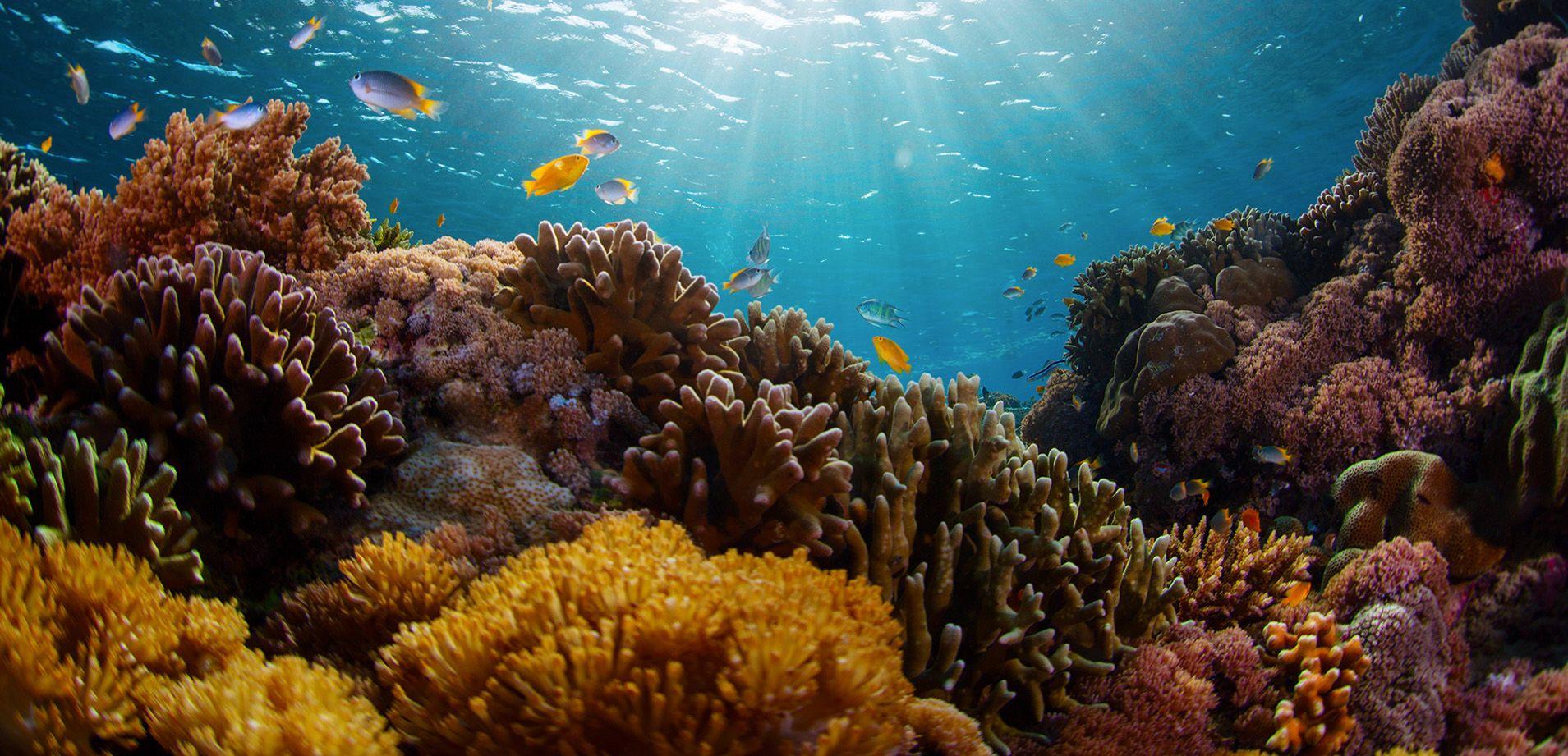
Globally, coral reefs are one of the most important facets of the earth’s ecosystem, but there are many threats that coral reefs face every moment of every day, including climate change, pollution, and tourism. The health of coral reefs relies on dynamic and symbiotic interactions amongst key functional groups of marine organisms such as fish, coral, and algae. Disturbances to the roles these play can lead to changes in the vital communal structure with adverse implications for coral reef biodiversity.
Accordingly, there couldn’t be a better time for all of us to take a few moments to learn more about coral reefs and to respect how we can help maintain and protect these amazing and diverse ecosystems from the myriad of threats that they are facing. While they took multiple generations to create, it takes but mere months to start to destroy. According to the Natural History Museum, coral reefs were formed evolving from prehistoric microbial & sponge reefs. They survived fine until humans started showing up. By the 1930’s and 40’s, reef decline was noticeable and measurable. By the 50’s, coral reefs decline was measured at an astonishing 50% in some areas – affected by water condition changes spurred on by humankind’s marine activities. Fast forward to the late 90’s, where more coral reef erosion had been measured and the ill effects of El Niño caused widespread coral bleaching, and reef death. For the next twenty years, climate change, pollution and tourism all contributed to another 15% of global coral reef decline. This trajectory has not since abated. Without changes, it’s estimated that within the next 25 years nearly all the world’s coral reefs will be affected with upwards of 75% facing high to endangered levels of damage.
Close to home, the U.S. Coral Reef Condition Status Report was developed in 2020 by NOAA’s Coral Reef Monitoring Program and UMCES’s Integration and Application Network using data collected in the six years between 2012 and 2018. The scores are set out as “Very Good,” “Good,” “Fair,” “Impaired,” and “Critical.” This report was based on four groupings when assigning a score: (1) coral and algae abundance, (2) reef fish populations, (3) influence of climate on coral reefs, and (4) human connections to reefs. Coral reefs in both the Pacific and Atlantic oceans received a “Fair” score in this, the first-ever condition status report for U.S. coral reefs. While the overall scores were “fair,” the report highlights coral reefs are vulnerable and declining; and it is important to note that the 'Fair' score is only a shade away from the 'Impaired' score. Some believe that we take this too lightly at our own peril.
The largest single contributor among the threats to coral reefs is climate change, according to the report. Warmer, more acidic seawater is negatively affecting coral reefs globally, no matter how remote they are. Chemically, this affects their growth, overall health and bleaches them, which if not corrected, eventually kills the reef. Heath Kelsey, director of UMCES’s Integration and Application Network said, “Our work in the Pacific and Atlantic Oceans shows a dire outlook for coral reef ecosystem health, from warming ocean waters, (over)fishing, disease, and pollution from the land.” Chris Golden is an assistant professor of nutrition and planetary health at Harvard T.H. Chan School of Public Health and associate director of the Planetary Health Alliance. On a Harvard T. H. Chan Public Health podcast (The connection between coral reefs and human health; Feb 21, 2019), Chris Golden stated: “So with climate change, there are multiple different impacts on fishery systems. So, one impact that you will see is that as ocean sea temperature rises, fish will move from the equator toward the poles. And so, what you see is an enormous decline and reduction in fish caught along the areas of the equator. And it’s predicted to decline by around 50% by 2050 in comparison to what we are seeing today.”
“The other ways in which this has impacted are through sea temperature rise and ocean acidification ... that can really harm coral reef habitats. And so, this could be driving coral reefs into coral bleaching. That key kind of foundational habitat for coral fishes then is no longer able to sustain those fish populations. And the stock of those fisheries rapidly declines, meaning that there’s less seafood available for local consumption.”
He continued: “We see that across the world, the rapid decline of fisheries will be destabilizing food security and impacting human nutrition in a variety of ways. We think that there are roughly three typologies by which countries might be affected. So, you have countries like the US, (Canada,) New Zealand, Japan, Sweden, where a local collapse of the fish stocks might not lead to massive changes in the diet. It could change the price dynamics. It could change what species are available in markets. But for all intents and purposes, those who were eating fish before will continue to eat fish. And those who were not eating seafood before will continue not to do so.”
Then, you have other countries in places like Africa and Asia where the scarcity of local fish availability may force residents to eat more of a local and basic vegetarian diet because wild or domesticated meats are too expensive. With little income to spend on supplements or (unavailable) fortified foods, they may experience increased micronutrient deficiencies as a result.
With ‘wealthier’ countries like Mexico & Brazil, the potential collapse of their own local fishing industries may have essentially the same effects as they may lose access to their traditional diets and move into a more ‘Western diet’ consisting of processed and fast foods. Declining health within these populations may follow suit in both instances.
Whilst the immense open ocean fish stocks are being consistently overfished, we now can see that the shallow water fishing stocks will be affected in a massive and critical way as well.
Fish stocks, overall, provide not just food for the global community, but also provide oil for the supplement industry, which has a huge appetite for omega fish oils. One of the largest and most robust categories, fish oils, provides much needed omegas for human health. As a matter of fact, according to a GlobalNewsWire release of June 30, 2022; a little-known fact is that the supplement and ‘functional food’ industry owns the major share of the global fish oil market – to the tune of USD $872 million in 2012, and which is expected to grow to USD $1,307 million in the next 7 years. Tremendous growth is expected from an already overfished commodity and with shrinking fish stocks projected.
Greg Cumberford, VP of Science & Regulatory for Natures Crops International, a leading global producer of non-fish-based omega oils recently stated that “So much of humanity’s ecological impacts come from our food choices. Perhaps this is no clearer than in omega-3 nutrition where more than 90% of the global supply comes from wild-harvested forage fish at the base of the marine ecosystem. Natures Crops International developed Ahiflower® oil to provide the world an ecologically regenerative source of complete and balanced plant-based omegas. Every acre of Ahiflower oil has the omega-3 oil equivalent of 500,000 anchovies. Every person who chooses Ahiflower oil for daily omega-3 wellness helps move a predominantly extractive global supply chain towards a regeneratively grown one that tangibly reduces pressure on ocean ecosystems.”
Coral Reef Awareness Week is from July 17th through July 23rd, 2023.

Women In Nutraceuticals (WIN) Companies Unite to Showcase Outcome-Focused Supplement Innovation at SupplySide Global
As consumers increasingly seek convenient, outcome-focused wellness solutions

Vitafoods Asia 2026: Strengthening Connections and Exploring Opportunity Across APAC
For Stratum Nutrition, industry events are about more than being present;

Stratum Nutrition's OVOLUX® Receives 2026 Ingredient Choice Award for Nutri-Beauty
OVOLUX® has been named the 2026 Ingredient Choice Award winner



.svg-6af5dfb7ccef8f01d163f9ebdf2f0df6.svg)
